Know Your Real Sales Engine
Over your coaching journey you’ll hear us talk regularly about measuring sales performance. When done well, it gives you the clarity to improve, refine and optimise every step of your sales process.
Two of the key metrics you need to understand are Strike Rate and Win Value %. If you have variable pricing across products or services, I strongly suggest you track both.
Strike Rate (Conversion Rate)
Strike Rate is simple.
Out of 100 quotes or proposals written, how many do you win?
If you write 100 proposals and convert 35, your strike rate is 35 percent.
It measures sales effectiveness and tells you how well you close.
But here’s the catch.
A high strike rate does not automatically mean high revenue.
If you are winning lots of small jobs but consistently losing larger ones, you can feel busy while underperforming commercially.
This is where the second metric becomes even more powerful.
Win Value %
Win Value % measures something slightly different.
Out of 100 dollars worth of quoted revenue, how many dollars do you actually win?
If you quote one million dollars across all proposals and win 420,000 dollars, your Win Value % is 42 percent.
This metric becomes critical when:
- You sell multiple products at different price points
- You quote both small and large projects
- You have tiered service offerings
Here’s why it matters.
You could have:
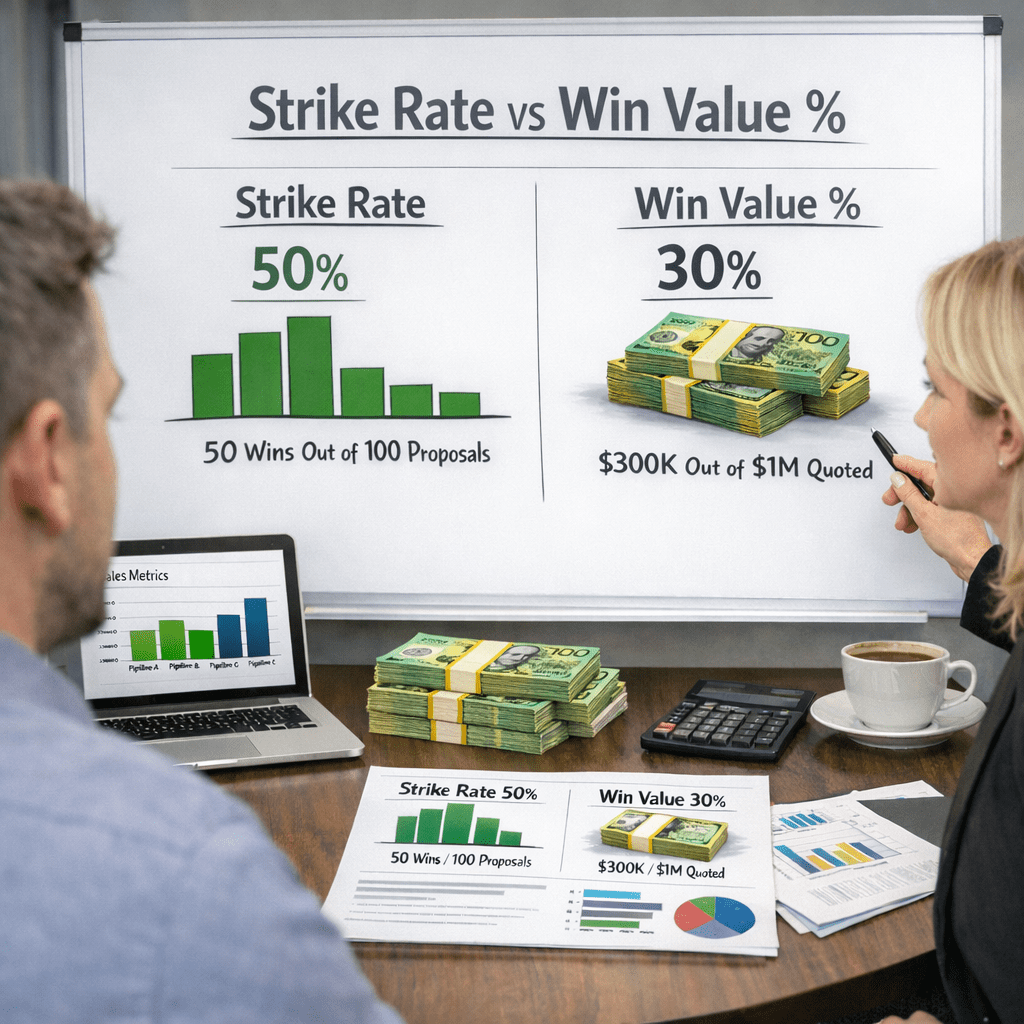
- A 50 percent strike rate
- But only a 30 percent Win Value %
That means you are winning half your deals, but mostly the lower value ones.
That could point to a strategy issue, positioning challenge or sales capability gap.
Conversely, you might have:
- A 25 percent strike rate
- But a 60 percent Win Value %
That means you are selectively winning higher value projects. Commercially, that can be incredibly powerful.
Why You Should Be Tracking Both
If all your products are priced similarly, strike rate on its own may be sufficient.
But if your pricing varies, tracking only strike rate can give you false confidence.
What you really want to know is:
- Are we winning enough deals?
- Are we winning the right deals?
- Are we discounting to win?
- Are we positioned correctly at premium price points?
When I helped sell our last company, Win Value % played a massive role in the due diligence process.
For ten years we had tracked our sales performance in our CRM. That meant we could demonstrate consistent repeatability in our sales engine. More importantly, we could model what would happen if a buyer increased marketing spend, expanded the sales team and grew the pipeline.
Measuring sales metrics allowed us to continually optimise performance year after year. It also became incredibly powerful when we eventually sold the business and were working to maximise value for our partnership group.
So whether you are the only salesperson in your business or you have a team responsible for generating your next customer, it is never too early to start measuring sales performance properly.
Because what gets measured gets improved. And what gets improved increases the value of your business for your tomorrow.
Cheers,
Darren Gloster
CEO – Australia & New Zealand
Entrepreneurial Business School