In the first two parts of this series, we’ve focussed on finding and selecting great talent. If recruitment is about choosing the right people, onboarding is about not wasting that choice.
Hand up, as a business leader and owner I’ve struggled with onboarding over the years.
I’ve put extraordinary effort into hiring, only to revert back to a “sink or swim” approach once I’ve had a team member become part of our journey, we were completely guilty of undercooking what happens next.
In my past we’d hire a great person
→ give them a login
→ introduce them to a few people
→ and let them “figure it out”.
In most cases the great ones would. But I’m sure I lost some team members that had potential but we didn’t support enough. Most of my career I’ve run service based businesses like consulting and coaching, and the impact of my poor onboarding leadership had horrible consequences for our reputation as the vast majority of the team are client facing.
In this third post in our recruitment series, I want to talk about onboarding, so hopefully you can learn from my losses and avoid some of the pitfalls or blind spots.
The Real Purpose of Onboarding
Onboarding is often mistaken for:
- Induction
- Admin
- Compliance
- “Getting them up to speed”
That’s surface level.
Great onboarding does three deeper things:
- Creates clarity
- Builds confidence
- Accelerates contribution
Onboarding is also a balancing act. It’s where you still have some freedom to identify a mistake you may have made in the recruitment process and terminate a relationship during probation, whilst more positively building confidence in the new team member of the bright future you will have together.
If someone voluntarily leaves in the first 6–12 months, it’s rarely because they lacked capability.
More often, it’s because they lacked:
- context
- certainty
- or connection
That’s an onboarding failure, not a hiring one and if we’re playing above the equator we need to owner that as a leader and business owner.
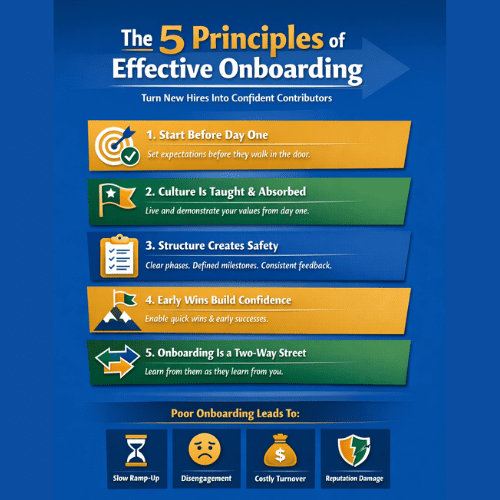
Principle #1: Start Before Day One
Onboarding doesn’t begin on someone’s first day. It begins the moment they say yes.
Before a new team member starts, they should already understand:
- why the role exists
- how success is measured
- what “great” looks like in your business
- and how they fit into the bigger picture
All of this can come from both the Talent Map and Big Picture Document that we discussed in Part 1.
It’s your job to remove uncertainty early. Uncertainty kills confidence, and confidence is everything in the first 90 days.
Principle #2: Culture Is Both Taught & Absorbed
Culture doesn’t magically “rub off”.
If you want someone to live your values, you must:
- name them
- explain them
- model them
- and reinforce them
It’s what we call at EBS – Our Points of Culture and Rules of The Game.
Early onboarding is when cultural standards are set silently or deliberately. What gets tolerated in the first few weeks becomes the benchmark and onboarding is the perfect place to set the standard and model the behaviours you want from your new team member.
Principle #3: Structure Creates Safety
One of the biggest mistakes I see is assuming experienced people don’t need structure.
I’ve found that high performers crave:
- clear expectations
- defined milestones
- regular feedback
We design onboarding with:
- clear phases (30 / 60 / 90 days)
- explicit outcomes at each stage
- and regular check-ins focused on learning, not judgement
Principle #4: Early Wins Matter More Than Perfection
Momentum matters. Try and intentionally design onboarding so new team members can:
- add value early
- experience a win
- and feel useful and grow quickly
Confidence compounds. There is the old football adage “if only you could bottle confidence.” When done well onboarding can help the team feel at home and layer their confidence in a period that is full of perturbation and apprehension.
The faster someone experiences impact, the faster they:
- take ownership
- lean in
- and start thinking like a leader instead of a new starter
Principle #5: Onboarding Is a Two-Way Street
Great onboarding isn’t just about teaching someone how you work.
It’s also about learning:
- how they think
- what strengths they bring
- where they’ll add disproportionate value
Some of our best improvements have come from fresh eyes in their first 90 days, when they’re not yet blind to inefficiencies we’ve normalised.
The Cost of Getting This Wrong
Poor onboarding leads to:
- slow ramp-up
- disengagement
- second-guessing
- and regrettable turnover
Which is expensive reputationally, financially and culturally.
By the time someone departs, the damage was usually done months earlier.
Final Thought
Recruitment gets the headlines.
Onboarding delivers the results.
If you want your hiring efforts to pay off, there are two questions to ask:
“Did we hire the right person?”
And
“Did we give them the right start?”
In the next post in this series, I’ll dive into performance, feedback, and retention and how the best businesses turn good people into long-term contributors.
Cheers,
Darren Gloster
CEO – Australia & New Zealand
Entrepreneurial Business School