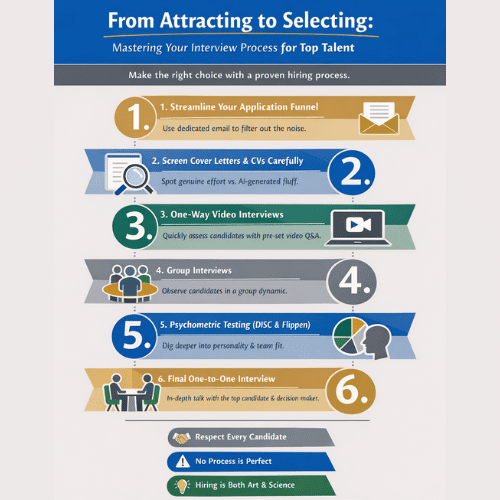
Attracting top-tier candidates is only the first filter. The real cost and the real leverage sits in what happens next. Too many businesses lose great people or make expensive hiring mistakes because their interview process rewards confidence, not capability.
In this post, we move beyond theory and into execution. You’ll see the exact steps we use to filter noise, protect time, and uncover who will actually perform in the role, not just talk well in an interview.
Step 1: Streamline Your Application Funnel
We start by ensuring candidates are genuinely engaged from the get go. Nobody has time to waste on tyre kickers or generic applications automatically fired off from platforms like Seek. One simple tactic we use is a dedicated recruitment email address. At EBS for example we use recruitment@ebs.org. It’s a small filter but a powerful one. Candidates who’ve read the ad followed instructions and taken the time to apply properly rise to the top quickly cutting down the noise immediately.
Step 2: Screen with Care Cover Letters and CVs
Next comes the application review. Cover letters are a must for us. They allow candidates to explain why they believe they’re right for the role. With the rise of AI this step has become even more important. You’ll quickly spot the difference between candidates who’ve leaned entirely on technology versus those who’ve balanced leverage with their own flavour and input. I’m all for using AI but when it’s done poorly cover letters become almost identical. When it’s done well candidates take the time to personalise their story and explain why you are the right fit for them and vice versa. Paired with a structured CV review this step helps narrow the field before we ever meet someone face to face.
Step 3: The Power of One Way Video with Hireflix
Once we’ve shortlisted we introduce Hireflix a one way video interview platform where candidates respond to preset questions in their own time.
This step is a game changer.
Ever had that feeling where you know within the first five minutes that someone isn’t going to be a fit but you don’t have the heart to cut the interview short and end up sitting through another 25 to 55 minutes.
Hireflix helps avoid that time drain. You design the questions upfront, review responses when it suits you and if someone isn’t a fit you can quickly and respectfully move on. Huge leverage for both sides.
Step 4: Group Interviews for Efficiency and Insight
After the video stage we bring candidates into a group interview. This isn’t just about convenience it’s about insight and leverage.
In one session we can
- Share role details once
- Answer common questions once
- Observe how candidates interact in a group setting
It’s a great way to assess curiosity communication and presence.
It also introduces a bit of perturbation. Some candidates will be visibly nervous, trembling voices, shaky hands and that’s okay. I don’t mark people down for nerves. In fact, it’s often a sign the role matters to them.
Step 5: Using DISC and Flippen for Psychometric Depth
We introduce DISC assessments at the group stage to better understand working styles and natural strengths. For finalists we go deeper with the Flippen profile giving us a 360 degree view of how others experience that individual.
Psychometrics are invaluable for understanding
- How someone will work with their manager
- How they’ll interact with you as the owner
- How they’ll complement or clash with the broader team
Talk with your coach about how to integrate psychometrics into your hiring process and how we can help debrief results pre or post hire.
Final Steps: The One-to-One Deep Dive
In the final one-to-one interview we tailor the conversation to the individual. We dig deeper into psychometrics explore real scenarios and ask candidates to think through role specific challenges.
We also involve other team members and always have a gatekeeper in the process usually the CEO or business owner to provide final input.
Yes it’s time consuming. Yes it takes effort.
But it pales in comparison to the cost financially and emotionally of unwinding a bad hire.
A Few Key Things to Remember
1. Always be respectful
Recruitment is a two way street. Respect candidates’ time and effort at every stage. Be transparent about the process communicate clearly as they move through stage gates and always let people know if they’ve been unsuccessful.
If someone reaches the final stages and asks for feedback take the time to give it. You never know who they know, they could become a client, refer a client or shape your reputation.
Your recruitment process is an extension of your brand and points of culture. Treat it that way.
2. This process isn’t foolproof
Earlier this year I calculated that I’ve personally hired close to 500 people, led thousands of interviews and reviewed tens of thousands of CVs over the last 25 years.
This process has evolved through hard lessons, rushing steps, skipping steps and not putting in the effort when we should have.
Even now I still get it wrong. People are complex and you never truly know until someone’s in the seat working with the team.
Be thorough but don’t be hard on yourself.
Hiring is still more art than science.
Hopefully these steps help you avoid costly mistakes and find your next 7-footer.
Cheers,
Darren Gloster
CEO – Australia & New Zealand
Entrepreneurial Business School