Fuel Price Volatility: The Silent Profit Killer for anyone who uses vehicles in your business
13 March 2026
The current geopolitical situation in the Middle East has meant we’re all feeling the impact at the pump.
If you run a business with vehicles whether it’s landscaping, electrical, plumbing, construction, freight, or maintenance services fuel is one of those costs that can quietly eat away at your margins.
Most business owners notice it when it jumps at the pump. What we rarely do is plan for the volatility or quickly adjust when spikes become significant and that’s where problems begin.
Fuel prices don’t move gradually. They move in spikes. A geopolitical issue, supply disruption, or refinery shutdown can push prices up 20–40% very quickly.
For a fleet-based business, that can be the difference between a profitable year and a painful one.
Why Fuel Volatility Matters More Than You Think
Let’s take a simple example.
Imagine a service business with:
- 8 vehicles
- Each travelling 25,000 km per year
- Average fuel consumption of 12L per 100km
That fleet will use roughly 24,000 litres of fuel each year.
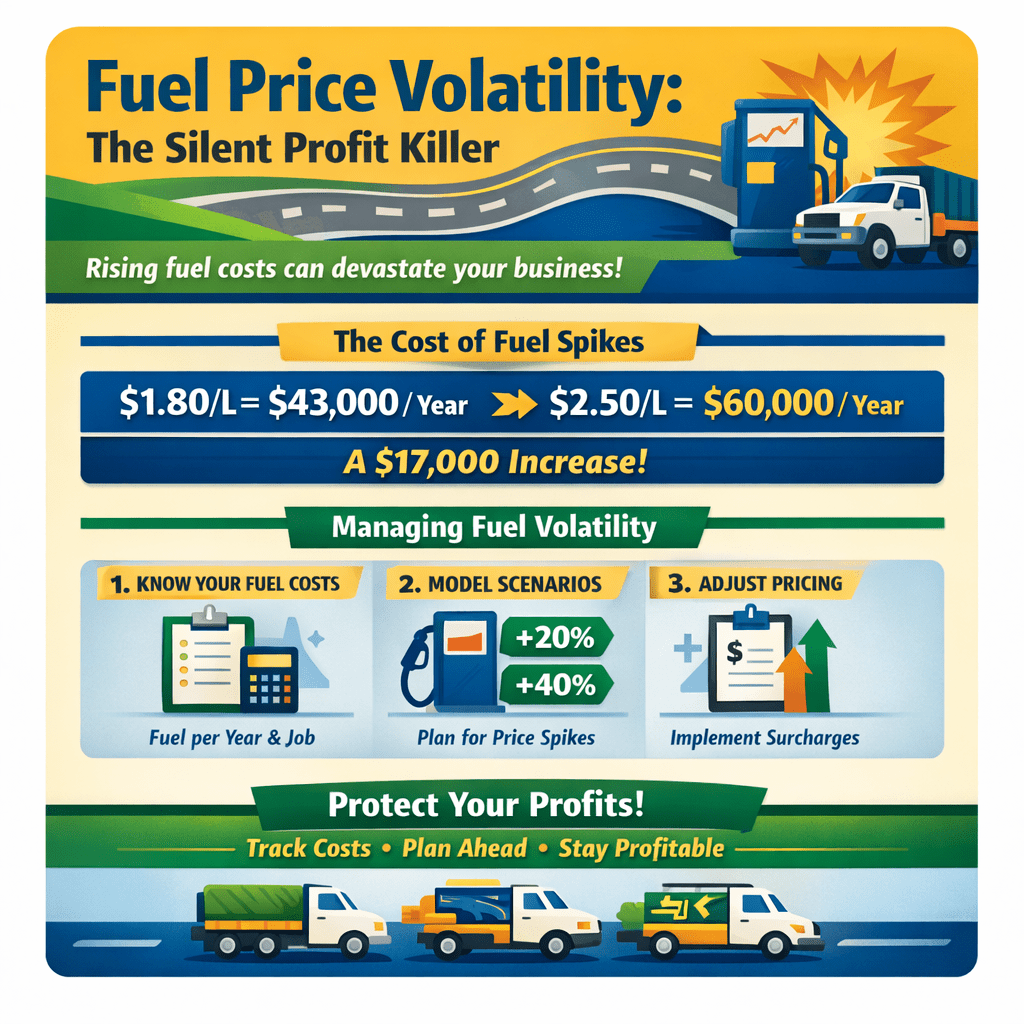
At $1.80 per litre that’s about $43,000 annually.
But fuel doesn’t stay still.
If prices increase to $2.50 per litre, that same fleet suddenly costs $60,000 per year.
That’s nearly $17,000 in additional cost without doing a single extra job.
For many small businesses operating at 10–15% margins, that kind of increase can wipe out a large chunk of profit.
The Problem: Most Businesses Don’t Model It
In my experience coaching business owners, most businesses manage fuel reactively.
Prices go up and they simply absorb it.
But businesses that operate fleets need to treat fuel the same way airlines and freight companies do as a variable input cost that needs to be actively managed.
Three Simple Steps to Manage Fuel Volatility
You don’t need complex financial models to stay ahead of this. Just a simple framework.
Understand your fuel exposure
Start with one basic question:
What does fuel cost us per year?
Then calculate:
- Fuel cost per vehicle
- Fuel cost per job
- Fuel cost as a percentage of revenue
Many business owners are surprised how large this number is once they see it clearly.
Model three fuel scenarios
Instead of assuming yesterday’s price will stay the same, model three scenarios:
- Current price
- +20% increase
- +40% increase
This immediately shows how vulnerable your margins are if fuel spikes.
Introduce a fuel adjustment strategy
Businesses that rely heavily on vehicles should consider a simple trigger system.
For example:
- If diesel exceeds $2.20 per litre → introduce a small fuel surcharge
- If diesel exceeds $2.50 → review pricing
- Large freight and airline companies do this routinely. Small businesses rarely do, but they should.
Fuel is a classic example of something business owners can’t control, but you can control how prepared you are for it. The businesses that stay profitable through volatile markets are usually the ones that:
- Know their numbers
- Model different scenarios
- And adjust pricing before profits disappear
It’s not complicated but it does take discipline. If you need some help with this jump into a quick session with your coach and take action as the current disruption isn’t likely to settle down anytime soon.
Cheers,
Darren Gloster
CEO – Australia & New Zealand
Entrepreneurial Business School