Last week, we flagged that performance appraisals would be the focus of this conversation. A recent coaching session made the timing feel spot on.
I was working with a great client who is making some real strides in their business. They’re experienced, they’ve been in business a long time, and they’ve led teams of all shapes and sizes. One of their team members has been with them for more than ten years and is a genuinely important contributor to the business.
The challenge they brought to the session wasn’t about capability or loyalty. It was about motivation.
Recently, they’d noticed some absenteeism creeping into the role. There was a fair bit of perturbation in the lead up to the Christmas holidays, and once or twice there had been “a pop”. They felt this person was a little stuck, but they couldn’t quite work out why.
I asked a simple question. Have you ever uncovered what really makes this person tick?
The answer was, not really. We thought we knew, but now we’re not quite sure.
So I followed up with another question. How do you approach performance appraisals or performance reviews?
Their answer was just as simple. We don’t do them.
That moment stuck with me. Not because it’s unusual, but because it’s common, particularly in small and medium sized businesses. I suspect many of our clients are in a similar position, working with good people, sometimes long serving people, yet lacking any structured way to understand what motivates them, how they’re really feeling in the role, or how they see the business and its leadership.
As usual, it made me reflect on my own experience.
In my previous business, we didn’t have a strong or disciplined approach to performance appraisals either. If I’m being honest, as a leader, as a team member, as a partner and as an owner, I undervalued them.
The founder of that business and I are passionate golfers. We even had a ritual called Mandatory Golf Friday. If we weren’t on the golf course by 4pm on a Friday afternoon, our week had been a failure regardless of what had happened in the business. It was good fun and something we always looked forward to.
All of my performance appraisals under his leadership consisted of us playing nine holes together. We’d talk briefly about my performance over the first couple of holes and then spend the rest of the round enjoying ourselves. There was nothing structured, nothing documented, and in hindsight, it could have been far more effective. We even negotiated my first equity purchase in that business on the golf course.
As that founder transitioned out of the business, my CEO at the time was also my business partner. He had more tenure and experience than I did, but our relationship was more like brothers than business partners. Our performance reviews often involved a few gin and tonics, sometimes two, sometimes three, occasionally five or six. Again, informal, undocumented, and ultimately not very useful.
It wasn’t until I joined Entrepreneurial Business School that my thinking on performance appraisals fundamentally shifted.
What I’ve learned since is that the real value of performance appraisals isn’t in delivering feedback to someone. It’s in creating a structure that allows feedback to flow both ways. When done well, appraisals help uncover what motivates people, how they actually feel in their role, how they experience you as a leader, and how they see the business they’re helping to build.
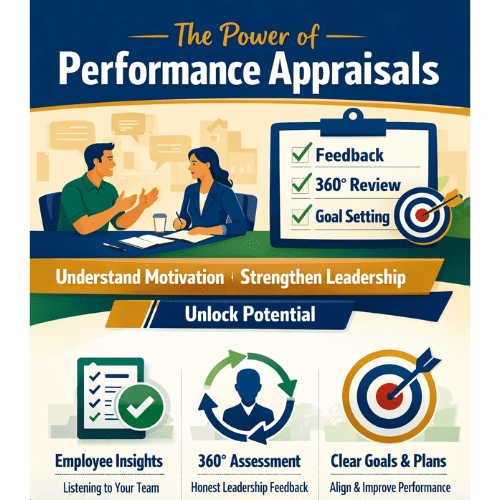
At EBS, we don’t rely on a single conversation or a once a year form. We use three distinct tools, each with a very specific purpose, and we have these conversations every six months.
The first is a set of review questions designed to elicit genuine responses from the team member. These questions are intentionally open and reflective. They ask people what they’ve learned, how they’ve grown, how satisfied they really are, where they want to go over the next one, two and five years, what support they need more of, and what they believe should not change.
I’ve had more than a few surprises emerge from these documents, facts and feelings that would never have surfaced unless the team member had been asked to stop and genuinely reflect on their role. Most people have a lot to say. They’re just rarely asked in the right way.
The second tool is the 360 Degree Leadership Assessment. This flips the lens completely. Instead of focusing on the team member, it gathers structured feedback on the leader. It explores whether the vision is clear, whether expectations are understood, whether the leader provides the right support, and whether they are building an engaged and motivated team.
This can be uncomfortable, but it’s invaluable. Leaders often discover gaps between how they believe they are leading and how they are actually perceived. If a team member is disengaged or unclear, the root cause is often their manager.
As Marcus Buckingham famously said,
“People don’t leave companies, they leave managers.”
The third piece is the review form itself, which is completed by both the team member and the leader. It aligns expectations around what the role requires, reviews performance together, clarifies focus areas, and creates a clear plan for what needs to improve over the next period. It’s more quantitative than the first two tools and allows progress or decline to be measured over time.
The biggest reframe for me has been this. Performance appraisals, when done properly, are not an administrative task or a compliance exercise. They are a listening tool. They help leaders stop guessing and start understanding. They surface motivation, highlight blind spots, strengthen trust, and create clarity before issues become problems.
Which brings me back to that original client conversation.
If you don’t have a structured way to ask these questions, you’re left relying on assumptions. And assumptions are a poor substitute for insight, especially when it comes to the people who matter most in your business.
Done well, performance appraisals don’t just improve performance. They deepen connection, strengthen leadership, and unlock potential that might otherwise remain hidden.
If you would like a copy of the templates we use at EBS, simply reach out to the EBS team and your coach will be happy to forward them to you. A discussion around this topic would also be a great addition to your next coaching session.
Cheers,
Darren Gloster
CEO – Australia & New Zealand
Entrepreneurial Business School